
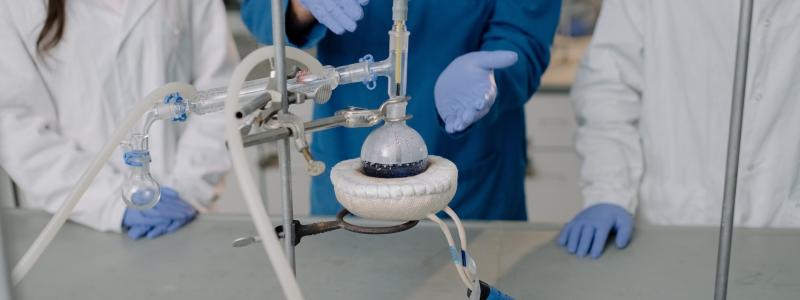
The American Chemical Society (ACS) recognizes Dr. Friesen’s decades of aerospace and materials innovation as his new review on fluoropolymers becomes a field-shaping resource for medical and industrial chemistry.
A research journey shaped by faith and unexpected opportunities
When Dr. Chadron “Chad” Friesen began his graduate studies more than twenty-five years ago, he was handed a project so challenging that the previous student left. He had no idea that this difficult beginning would lead him into aerospace research, federal defence collaborations, a global chemical corporation, and now one of the highest honours in his field.
“I thoroughly enjoyed my time in industry,” he said. “I had no rational reason to leave. But I felt a nudge from the Lord, and he used people around me to encourage me in a new direction.”
That step of faith led him to Trinity Western University, where he has now taught chemistry for a quarter of a century. He currently also serves as chair of the Department of Chemistry at TWU. Along the way, the research that began in that daunting graduate lab kept growing in influence.

Breakthrough aerospace research developed in partnership with DuPont
This year, the ACS selected Dr. Friesen as a 2026 recipient of the Cooperative Research Award in Polymer Science and Engineering. The ACS is the largest chemistry organization in the world. Its awards are globally recognized and often compared to the Olympics of chemistry because of their competitiveness.
Friesen will receive the honour in Atlanta this March alongside his long-time collaborators, Dr. Joseph S. Thrasher and Dr Jon L. Howell.
The award celebrates major breakthroughs created through university and industry partnerships. In this case, the partnership involved the University of Alabama, Trinity Western University, and the American multinational company DuPont, a materials science leader founded in 1802. DuPont has created iconic innovations including Kevlar, Teflon, and nylon, and specialized materials used in protective gear, airplanes, satellites, and medical devices.
Friesen described the email notifying him of the award as both surprising and humbling. “My colleagues and family were very excited. They knew it was an honour,” he said. “I received many messages from research colleagues around the world.”

From challenging student project to global impact
As a graduate student, Friesen worked at both the University of Alabama and DuPont, where he was placed in the middle of an ambitious aerospace project. Engineers needed new lubricants that could survive extreme heat inside jet engines, satellites, rockets, and NASA-related systems.
To solve the problem, he and his mentors examined the molecules themselves. “We realized certain materials behave better in harsh environments than others, and we had to figure out why,” he said.
Their research eventually led to a DuPont product called KrytoxTM XHT. It became one of the best high-temperature lubricants in the aerospace sector and is still used in systems where failure is not an option.
The work opened doors for Friesen to collaborate with the Canadian Armed Forces and with the United States Air Force. These partnerships continued after he joined TWU.
“Research is life giving,” he said. “Students may not always realize that society has many difficult problems that are unsolved. We need people who can solve hard problems.”

A second milestone: a major Chemical Reviews publication
Alongside the award, Friesen also published a high-impact review article in Chemical Reviews, one of the most influential journals in chemistry. Articles in this journal do not report a single experiment. Instead, they serve as a blueprint for an entire field—a definitive guidebook that scientists, doctors, industry leaders, and policymakers rely on to make decisions.
Friesen and his co-authors reviewed more than five hundred scientific papers on fluoropolymers, which are essential in medical technologies. These materials help create devices that can safely deliver drugs, withstand sterilization, or operate inside the human body.
The review explains what fluoropolymers do well, where the weaknesses are, and where future research should go. It also helps the public understand an often-confusing debate. Online conversations frequently criticize fluorinated materials, but Friesen warned that decisions based on fear or incomplete information can be harmful.
“If you ban fluoropolymers, everything in that review that is currently in medicine would be gone,” he said. “That would make an immediate negative impact. You cannot make decisions based on emotion with nothing backing it up.”
Completing the Chemical Reviews paper required extraordinary commitment. Although the team was given two years to complete a review involving more than five hundred scientific papers, Friesen spent both summers in Canadian Armed Forces reservist training with no access to his project. This meant the work had to be compressed into the eight-month academic year. Friesen and his graduate student, Jason Pulfer, met week after week during the school year, teaching and conducting research during the day and reviewing articles at night.
“We were burning the candle on both ends,” Friesen said. After finishing the manuscript, they navigated permissions, figure preparation, and extensive editing before the article was accepted. The intensity of this timeline not only demonstrated Friesen’s dedication but also gave Pulfer a rare career launching opportunity to co-author a major publication under highly demanding conditions.

A legacy of service through science, teaching, and leadership
Friesen’s recognitions reflect not only his technical expertise but also his enduring commitment to students. TWU undergraduates often begin research in his lab and later continue through graduate programs at Simon Fraser University. While chemistry can feel intimidating to new students, he believes the difficulty is part of the formation.
After twenty-five years at TWU, his greatest joy remains watching students grow into researchers and professionals who will shape their communities.
“It has been humbling to see how well they are doing,” he said. “They wanted to learn and now they are impacting society.”
About TWU's Faculty of Natural & Applied Sciences
At TWU, your science education will be delivered by capable, committed Christian educators who are not only experts in their fields but scholars who continually advance their disciplines through research. Learn more at the Faculty of Natural and Applied Sciences.
About Trinity Western University
Founded in 1962, Trinity Western University is a global Christian liberal arts university dedicated to equipping students for life. Uniting faith and reason through Christian teaching and scholarship, TWU is a research institution offering undergraduate and graduate degrees in the humanities and sciences as well as in several professional schools. It has campuses in Canada in Langley, Richmond, and Ottawa. Learn more at www.twu.ca or follow us on Instagram @trinitywestern, Twitter @TrinityWestern, on Facebook and LinkedIn. For media inquiries, please contact: media@twu.ca.