
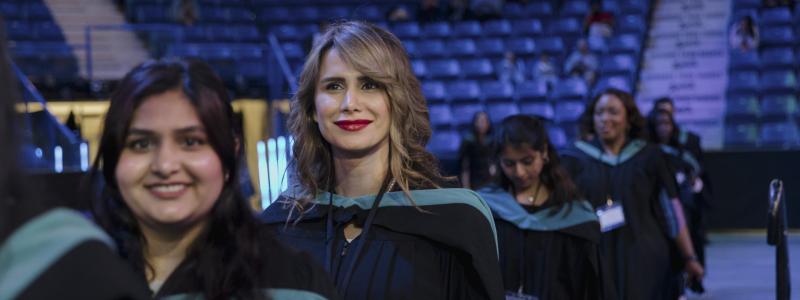
On a late summer evening in 2023, the air over Langley was still warm when Niloufar Pashaki (’25) stepped out of Douglas Hall and into a courtyard she had never seen. Her suitcase wheels clicked over the paving stones. Jet lag clung to her shoulders. A friend, eager to welcome her, insisted on one quick tour of campus before she rested.
They walked past dorm windows glowing with lamplight. Someone laughed from an open balcony. Crickets buzzed at the edge of the lawn. As they turned a corner near the campus cross, the sound shifted. Hundreds of students stood in a wide circle around the cross, candles in their hands, faces lifted toward the sky as worship songs rose into the evening air. Pashaki stopped walking.
“In our church, we always prayed for the freedom to worship outside,” she said. “Seeing that on my first day felt like God was showing me something. Showing me that here in Canada, I would be free to worship him freely, just like I prayed for. He answered my prayer.”
She stood there for a long moment as the music folded over her. After years of living faith quietly, that scene, a circle of students and a wooden cross against the evening light, became her first imprint of a place that would slowly reshape the course of her life.

Leaving home when life stopped moving
Yet her days had once felt very different. As a girl in the Middle East, Pashaki sat at the edge of a small kitchen watching her mother and grandmother cook traditional dishes. Steam rose from pots of rice. Fresh herbs were chopped with confident strokes. Cooking became her quiet language of love.
At school, English did not come easily at first. Her mother enrolled her in extra classes, hoping to open more opportunities in the future. Slowly the language became familiar, and when it came time to choose a university path, she selected English translation.
Her degree led to work as an interpreter for a company importing goods from China. At first, she worked in several roles including administrative assistant and interpreter, helping teams communicate across languages and cultures. Her CEO noticed the care she took with details and the way she listened and moved her into sales.
“I was very introverted,” she said. “Sales was something I never imagined doing.”
But he believed in her ability and encouraged her to try. Over time, she grew into the role and eventually became a sales and commercial manager, working with the company for more than a decade. “He trusted me,” she said. “He encouraged me to come out of my shell. That changed my path.”

Within a few years, she was a sales and commercial manager. Yet the country around her kept shifting. Sanctions deepened. Opportunities shrank. The future narrowed. In 2018, the rhythm of her life in the Middle East was measured not by semesters but by deadlines and economic uncertainty.
“It felt like running on a treadmill,” she said. “No matter how hard you work, you stay in the same place.”
She tried to create new pathways. A visa to the United States was denied. A business venture in Dubai collapsed, leaving her discouraged. A friend studying in Canada encouraged her to consider Trinity Western University. She applied to the Master of Arts in Leadership and, when she was accepted, chose courage instead of fear, recalling her life’s verse to mind every step of the way. “Have I not commanded you? Be strong and courageous. Do not be afraid. Do not be discouraged, for the Lord your God will be with you wherever you go.” Joshua 1:9
A faith story written across years
Pashaki’s spiritual journey began long before she arrived in Canada. She grew up in a Muslim household and was largely raised by her grandmother while her parents worked long hours. Her grandmother was deeply devoted, praying five times a day, and as a child, Pashaki often joined her in prayer.

“I always talked to God like a Father,” she said. “Even when I was six years old.”
At thirteen, after passing an important exam, her mother took her to a jewelry shop to celebrate. Among the gold and silver pieces, Pashaki chose a simple cross necklace. She did not understand why. She only knew she felt drawn to it. Years later, a cousin began sharing about Jesus and gave Pashaki a Bible. At first she resisted.
“You have your religion, and I have mine,” she told her cousin.
A few years later, at age 17, Pashaki's grandmother died. Grief pressed in. One night, she had a dream that felt more like a vision. In the dream, she stood in her grandmother’s home, now overrun with white mice, her biggest childhood fear. Her grandmother stood in their familiar prayer corner, hand raised toward the ceiling. Her mother appeared holding a Qur’an, urging them to recite it.
But her grandmother looked upward and said something unexpected.
“Don’t you see? Jesus is here. We can ask him, and the mice will leave,” her grandmother said.
Every detail stayed with her. When a cousin later invited her to an underground Christian community, she went cautiously. Quiet curiosity became faith. Across continents, she and that same cousin, now in the United States, still pray together faithfully and see their prayer fellowship as their own small church.
“In our little church, God truly answers prayer,” she said.
A campus that felt like home
One of Pashaki’s prayers had always been to experience Christianity openly and student life to the fullest. At TWU, she finally stepped into the kind of university life she had once imagined but never experienced due to being a commuter and working full-time during her undergraduate degree in the Middle East. “Sometimes God gives you something years later when the time is right,” said Pashaki.

She lived in residence and learned the rhythms of campus life. Professors in the Leadership program introduced her to frameworks that reflected values she had already practiced in her career, especially the idea of servant leadership. She soon stepped into leadership roles. She became a residence assistant and Christian events coordinator, supporting international students navigating the same mixture of hope and homesickness she once felt.

“I understood what they were feeling,” she said. “I wanted them to have moments of joy. Moments where they could breathe.”
She remembers organizing a Graduate Student Association Easter gathering under clear skies. Students shared brunch outdoors and listened to speakers reflect on faith and life. At another event around Valentine’s Day, couples spoke about how Jesus had worked in their lives. Students who had never opened a Bible before laughed as they matched verses in an icebreaker game.
“When people came and listened, you could see the hope on their faces,” she said.
Carrying home with you
Throughout her time in Canada, unrest in the Middle East intensified. Messages from home arrived at unpredictable hours. Some expressed fear—others determination.
“You carry your country with you,” she said. “Even when you are far away.”
Her colleagues noticed the days when the weight of home settled visibly on her shoulders. They checked on her quietly, offered conversation, and helped her stay steady.
“In crisis, there are three words to describe how people communicate: sympathy, empathy, and pity,” she said. “Here, people choose empathy.”

She also hopes people understand something often overlooked about Middle Eastern women. “We have educated, strong women in my country,” she said. “They are brave. They deserve to be seen as they truly are.”
A new chapter & an old dream
Soon after completing her degree in 2025, a friend sent her a posting for a graduate student life coordinator position at TWU. She applied and was offered the role.
In a season marked by uncertainty at home, the role felt like an anchor. “I am grateful for this position and for the people God has placed in my life,” she said.

Now, with a measure of stability, a childhood dream has begun to resurface. She remembers the smell of spices in her grandmother’s kitchen, and the way simple ingredients became meals that made people feel cared for. She does not know whether that dream will become a restaurant, a café, or something new. For now, it rests like a recipe written in the margins, waiting for the right moment.
“In my heart, I know that God gives what is needed at the right time,” she said.
From whispered childhood prayers to the dream she still calls miraculous and from hidden worship to a courtyard in Langley where voices rose freely into the heavens, Pashaki’s story has been shaped by unexpected openings. Each chapter holds its own hope, and as she steps into what comes next, she carries that hope with her: steady, resilient, and deeply alive.
About Trinity Western University
Founded in 1962, Trinity Western University is a global Christian liberal arts university dedicated to equipping students for life. Uniting faith and reason through Christian teaching and scholarship, TWU is a research institution offering undergraduate and graduate degrees in the humanities and sciences as well as in several professional schools. TWU has its main campus in Langley, B.C. and campus sites in Richmond, B.C. and Ottawa, Ont.
Learn more at twu.ca or follow @TrinityWestern on Instagram, Facebook, LinkedIn, and YouTube. For media inquiries, please contact media@twu.ca.