
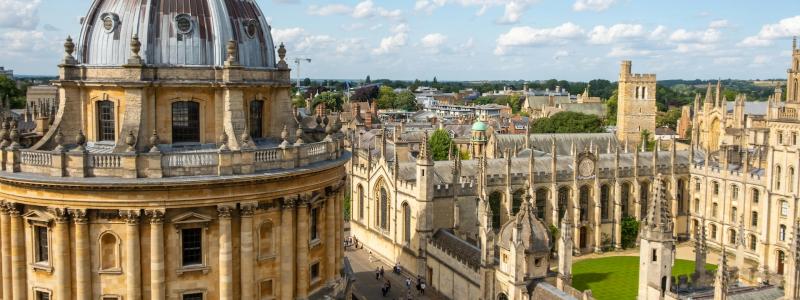
Trinity Western University graduate Marcus (ZiHao) Wang (‘19) is heading to the University of Oxford in September 2026 to pursue a DPhil in Theology and Religion, one of the world’s most competitive doctoral programs. Along with his acceptance, Wang was awarded the Clarendon Scholarship, a rare, fully funded graduate scholarship that covers full tuition and provides a living stipend, awarded to top applicants from around the world based on academic excellence and research potential.
Oxford receives tens of thousands of graduate applications each year, and Clarendon Scholarships are awarded to only a small percentage of applicants across all disciplines, making the award one of Oxford’s most prestigious academic honours for graduate study.
Wang’s proposed research comes at a particularly significant moment. As artificial intelligence rapidly reshapes education, work, relationships, and decision-making, researchers across disciplines are increasingly asking not only what AI can do, but what it means for human identity, meaning, and belief. Wang’s research directly explores how Christian theology can speak meaningfully to a generation shaped by digital technology and artificial intelligence.
For Wang, however, the road to Oxford did not begin with an application. It began years earlier with a question that would shape the direction of his life: What is the meaning of life?

A search that led to Trinity Western
“I was interested in the meaning of life,” Wang said. “Questions like, what is the meaning of life? Is there life after death? These kinds of questions led me to look into philosophy.”
His search began with Chinese philosophy, including Confucianism and Daoism, traditions that explore humanity’s relationship with what is ultimate and eternal. But one question remained. “The question that was not solved is, how can the finite creature become united with the infinite Creator?” said Wang.
As a child, he encountered a verse that stayed with him: John 14:6. “When Jesus says, ‘I am the way and the truth and the life,’ to me that was a very astonishing claim. He is claiming that he can solve that infinite gap.” The claim that Jesus is “the way” was particularly striking to him because Daoism also centres on the concept of the Dao, meaning “the Way,” understood as the ultimate source and order behind the universe.
After coming to Canada in 2013, Wang enrolled at Trinity Western University, where he studied a BA in philosophy and religious studies and began exploring Christianity through the intellectual tradition of the Church represented by St. Thomas Aquinas and the Church Fathers.
“I did not just want to know what Christianity teaches,” he said. “I wanted to know, ‘Why is Christianity true? Do we have a basis to argue for that?’” Wang later found peace in his quest and was baptized soon after.
Research, teaching, and a new direction
Wang then completed a Master of Arts in Interdisciplinary Humanities with a philosophy specialization at TWU (2019–2022), where his thesis focused on the relationship between modern science, philosophy, and the Christian understanding of creation. That research became one of the intellectual foundations that would eventually lead him toward doctoral work in theology and philosophy.
Today, Wang serves as an instructor of philosophy at several large local universities, while also working as an academic content coach at TWU. In his teaching and coaching roles, he mentors students through hundreds of appointments and study sessions each year.
“I have not found anything in life that feels more satisfying and makes me feel closer to Christ than when I can pour myself into a student and see them flourish,” Wang said.
During his years of teaching, he began to notice how deeply digital technology was shaping students’ lives, attention, and sense of identity. This observation led him to the work of 1960s media theorist Marshall McLuhan and to questions about theology in a digital world.
“How can theology effectively communicate the gospel in a way that fulfills the deepest yearning of the digital audience: the need for immersion, belonging, and participation?” said Wang. “These are the questions I want to explore at Oxford.”

From TWU MA to Oxford DPhil
At the University of Oxford, his doctoral dissertation will explore how Christian theology can respond to the challenges of the digital age, including artificial intelligence, media, and the human search for meaning and belonging in an increasingly technological world. His research will draw on the Christian philosophical tradition, the thought of St. Thomas Aquinas, the Church Fathers, and the early Christian doctrine of theosis and deification as creation's participation in the Divine Nature (2 Peter 1:4) through Christ, engaging questions about technology, media, and what it means to be human.
As Wang prepares to leave for Oxford this fall, he sees the move not simply as an academic opportunity, but as a continuation of the work he began at TWU: thinking about faith, reason, and how Christianity is relevant today.
“These ideas are much bigger than me,” he said. “This is God’s story, and I am trying to figure out my place in it; God decided to offer me a place.”
About Trinity Western University
Founded in 1962, Trinity Western University is a global Christian liberal arts university dedicated to equipping students for life. Uniting faith and reason through Christian teaching and scholarship, TWU is a research institution offering undergraduate and graduate degrees in the humanities and sciences as well as in several professional schools. TWU has its main campus in Langley, B.C. and campus sites in Richmond, B.C. and Ottawa, Ont.
Learn more at twu.ca or follow @TrinityWestern on Instagram, Facebook, LinkedIn, and YouTube. For media inquiries, please contact media@twu.ca.