
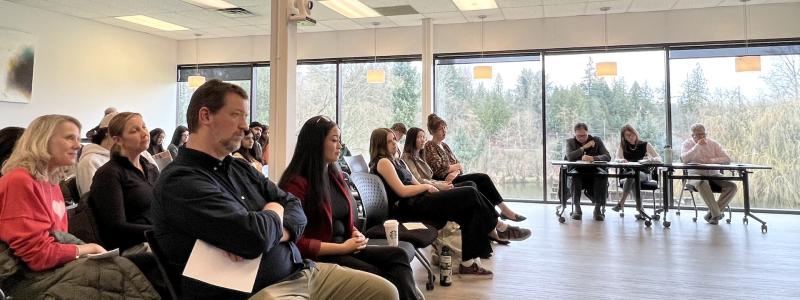
On March 4, the Glass Room in the Norma Marion Alloway Library was filled with a quiet kind of anticipation. Students, faculty, and friends gathered, not for a lecture, but for something far more difficult. Five graduate students were about to attempt what few researchers would likely be able to do. They were going to explain their life’s work in just three minutes
The Three Minute Thesis, or 3MT, is an international research communication competition that began at the University of Queensland in Australia in 2008. The competition, hosted at Trinity Western University by the Office of Graduate Studies, asks graduate students to present their research using only one slide and spoken word. No props. No videos. No extra time. They're given just three minutes to make the audience understand and care. Students compete first at their own universities, and winners can advance to regional, national, and international competitions. The goal is not only to summarize a thesis, but to communicate complex research clearly and show why it matters beyond the university, a skill that is increasingly important in a world where research must reach the public, policymakers, and communities.
What followed was not just a competition. It was an afternoon of stories.

Research that begins with people
Each presentation began with a question, but behind each question was a group of people whose lives shaped the research.
- Mark Parinas focused on caregivers of children with chronic illness. His research identified moments that either support or hinder mindfulness in caregiving. His presentation reminded the audience that caregiving is made up of small moments and that even in exhausting seasons, presence can still be learned.
- Hsin (Jessie) Chen explored emotional suppression in Asian communities and how it shapes mental health help seeking. Her research addressed the silence many people live with and asked what happens when cultural strength becomes emotional isolation. Her work pointed toward the importance of understanding culture when we talk about care.
- Liz Snell shared the spiritual stories of single, childless women entering midlife. Her research explored calling, identity, and faith in a life stage that is often overlooked. Her presentation gave language to stories that are rarely told, and in doing so, gave dignity to experiences that are often invisible.
- Netanya Castillo’s research began with grief. Her work connects ancient biblical mourning practices with modern neuroscience and trauma research, exploring how communal rituals help the brain process loss. Her presentation suggested something both ancient and new. Grief was never meant to be carried alone.
- Abigail Broadhurst spoke about adolescents who spend their lives helping others. Her research examined vicarious trauma and the emotional cost of caring at a young age, but it also explored something quieter and more hopeful. Growth is possible even in the presence of pain.
Together, the presentations formed a mosaic of research grounded in compassion, faith, mental health, relationships, and human resilience.

A moment of recognition
At the end of the afternoon, Liz Snell won first place and also received the People's Choice award. Abigail Broadhurst received the second place award for her research on adolescents and vicarious trauma. The competition also featured a keynote address by Dr. Kevin Schut, dean of the School of Arts, Media, and Culture, who spoke about the importance of communicating research in ways that serve both the academy and the world beyond it. Judges Melissa Au, Darcy Gullacher, and Scott Macklin evaluated each presentation, while Dr. Julie Frizzo Barker and Dr. Curtis Congo provided training and coaching to help students prepare for the competition.
The event was the result of many people working behind the scenes, and the Office of Graduate Studies expressed its thanks to all who participated and helped make the event possible.
Why three minutes matters
A thesis or dissertation can be up to 80,000 words. It can take years to research, write, and defend. But the Three Minute Thesis has a different focus and can be summed up in these questions:
- If your research really matters, can you explain it simply?
- Can you explain it in a way that makes someone want to listen?
- Can you explain it in a way that makes someone remember?
On March 4, five TWU graduate students did exactly that. They stood in front of a room with one slide behind them and years of work behind that, and for three minutes, they gave voice to their research. And for those three minutes, the room was very quiet, because everyone was listening.
About Trinity Western University
Founded in 1962, Trinity Western University is a global Christian liberal arts university dedicated to equipping students for life. Uniting faith and reason through Christian teaching and scholarship, TWU is a research institution offering undergraduate and graduate degrees in the humanities and sciences as well as in several professional schools. TWU has its main campus in Langley, B.C. and campus sites in Richmond, B.C. and Ottawa, Ont.
Learn more at twu.ca or follow @TrinityWestern on Instagram, Facebook, LinkedIn, and YouTube. For media inquiries, please contact media@twu.ca.